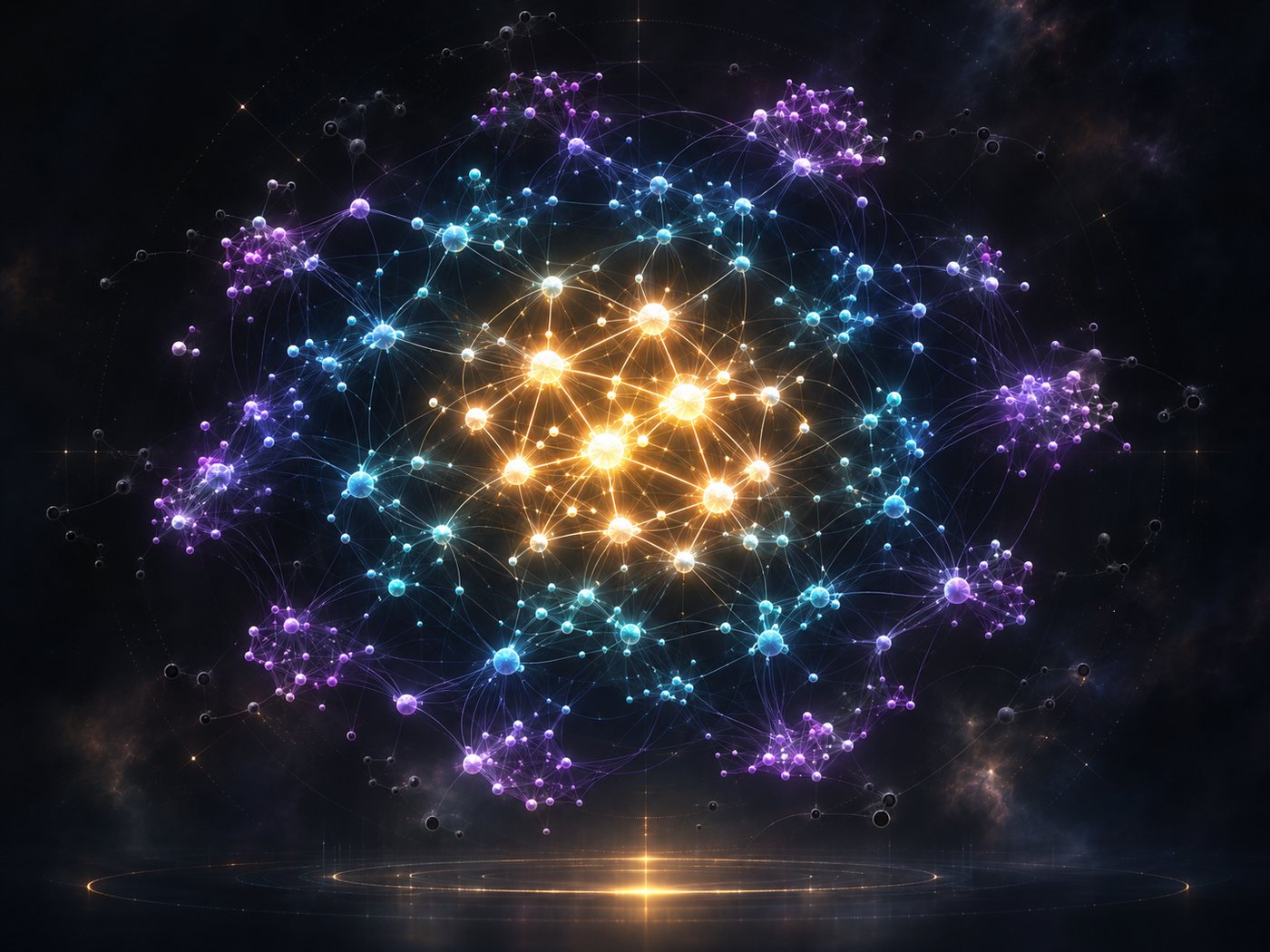
Concept art · About Luke. Each labelled place in the picture is a link.
About Luke Spooner
Luke Spooner · Independent Researcher · Cerebral Frame
Trained as a physicist; works as a systems engineer. He builds software that keeps an honest record of what happened and a live picture of what is probably true now.
About Luke, in one line
Luke Spooner is a physicist turned systems engineer who builds software that keeps an honest record of what happened and a live picture of what is probably true now.
In one paragraph
Luke Spooner is a physicist turned systems engineer. He builds software that keeps two things apart: a plain record of what actually happened, and a model of what is probably true now, with the uncertainty shown rather than hidden. One idea runs through all of it: a belief engine (Umwelt), a quantum farming game built on a real simulator (SpaceWheat), a finished browser game, a small work compiler that runs a team of AI agents one refereed step at a time (Semantica), and a consultancy that draws the same picture for one small company at a time (Cerebral Frame). Off the keyboard he is a partner dancer across twenty-eight styles. He runs his repositories under a written law that several AI seats and one human follow, and publishes the record of it, failures included, on this site.
In one page
Luke Spooner trained as a physicist and works as a systems engineer. The question under everything he builds is simple to say and hard to keep: how does a system act in a world it cannot fully see without lying to itself about what it knows? His answer has two parts. Keep a plain, append-only record of what actually happened. Separately, hold a belief about what is probably true now, and show its uncertainty instead of hiding it. A number nobody measured reads dark, never zero.
That idea has several bodies. Umwelt is the engine: a belief held as a quantum state over a graph, run on ordinary computers, with the honesty rule built in; where a cleverer filter lost to a two-line blend on real data, the engine says so and ships with it off. SpaceWheat is a farming game with a real quantum simulator underneath, where players learn superposition and measurement by growing wheat. Eukaryotic Eucharist is a finished browser game, closed on purpose. Semantica is a small work compiler: two desks, refereed packets run one at a time, an append-only tape. Cerebral Frame is the consultancy, which draws the same picture, a Frame, for one small company at a time and then builds the one thing the Frame says is costing most.
He builds most of this with a team of AI agents and has had to learn, the expensive way, how to run them: one lease per task, a referee instead of trust, a named list of the things only the human can do, and a public record of what each seat claimed and what the tests actually proved. The record is this site, The Broadcast, which shows what the machine behind the work is doing, including when it is dark.
Off the keyboard he is a partner dancer: twenty-eight styles and, by his own count, about 18,000 hours on the floor. Partner dancing is the oldest version of the problem his software works on. Two people coordinate in real time with no shared script and no words, one leads and one follows, signals arrive late, and a missed step has to be repaired without stopping the music.
On stage he talks about operations, about putting agents to work, and about the difference between a measured zero and a blank. Everything he says links to a measured line on this site, including the zeros.
Affiliation
Independent Researcher. Cerebral Frame, the consultancy.
Terrarium Store: your neighborhood is more prepared than it knows.
Civic Papers: FEMA Public Assistance paperwork with a checked evidence trail behind every number, for small applicants.
Toys: a hammock-trebuchet calculator and a three-layer drawing game.
Three years, in order
For anyone who has wondered what I have been doing. The short version: one idea, built in several bodies, with the failures left in.
Luke’s position · An open research bet
The wager
Could intelligence emerge and develop in a general-purpose medium whose parts can combine and adapt through experience? I want to explore what happens when you build a place for thought to take shape without specifying each operation it might need.
The artistic ambition is to make my experience of thought as moving, overlapping shapes and associations into something people can inspect. Intelligence beyond human ability is a long-range aspiration.
Concept art · Epistemic Constellation
Every system that has to act in a world it cannot fully see keeps two things: a record of what happened, and a belief about what is true now. A household does this. A business does this. A cell does this. For three years I have been building machines that do it on purpose — where the record is a plain ledger and the belief is held the way physics holds uncertainty, as a quantum state over a graph. That pair has a name now, Strand Theory, and an engine, Umwelt. Everything below is a project built on it.
Dates come from the public record where the record has them. Where it does not, the entry says so.
Before
to 2024
Physics training; years in manufacturing and technical sales, watching companies run on spreadsheets, inboxes, and one person's memory. The question that would not leave: why does every operation keep its truth in people's heads, and what would it take to keep it somewhere honest instead?
Temple Train and the first vocabulary
2024
The first attempt at the picture: one track, stations that load context, then station-specific verbs. Alongside it, the first vocabulary: strands and nexuses (threads of work, and the points where they meet), meant to describe a house, a market, a mind and a cell with the same words. This is the layer later called Semantica1: emoji-keyed JSON, tiny scripts, one-dimensional flow. Read now, not run.
proof · Named in the task desk’s own charter (semantica3 AGENTS.md).
dark · Month-level dates are not recorded.
Semantica2: the honest failure
2025 – 2026
The vocabulary grew organs: a 95,000-line system of workers, gates and process flows, and 3.7 GB of vitals it wrote about itself. It worked in places and could not be carried. It is frozen, not deleted (a writing ban, not a deletion), and the lesson is written into every charter since: hundreds of kernel lines, not tens of thousands; code small enough to carry.
proof · FREEZE.md in the task desk’s repository names what may never be imported again.
SpaceWheat: the math under a game
2026, spring
A farming game in Godot whose engine is a real quantum simulator — sparse-Hamiltonian evolution, a thousand-line gate library, up to fifteen qubits. Players learn superposition and measurement by farming. It is the same belief-over-ledger shape wearing a playful body, and it is in its release push.
proof · Fleet card: SpaceWheat, SHIPPING; releases on GitHub: v0.2.0 (Linux) published 16 June 2026 (Pacific), v0.1.7-alpha (Windows) published 18 October 2026 (Pacific).
Eukaryotic Eucharist ships
2 July 2026
A small algal-cell roguelike, playable in the browser. Simple local rules, emergent life, finished and closed. It is on the log as proof that things here get finished — and its ecology was the first game to carry a tuning receipt from the Umwelt engine.
proof · Live at aquantumarchitect.github.io/eukaryotic-eucharist.
Two papers begin
6 July 2026
Drafting starts on the Quantum Intelligence Architecture paper — the recurring shape across the house brain, the farming simulator, and the semantic engine — and on a paper about burst-pattern solo systems building. Papers come after machines here, never before.
proof · Dispatch: strand-theory-keel.
Umwelt is extracted
10 July 2026
The engine becomes its own thing: a domain-free library with the belief field, the ledger replay, the lint that refuses domain words, and the shadow-first rule for outputs. It boots blank into a world it has never seen and comprehends it; that is one of its offline proofs. The default estimator is a two-line blend because it beat the full quantum filter on real data, and the engine says so.
proof · umwelt repo, first commits P0–P2 on 2026-07-10; proofs/blank_slate.py.
The Broadcast
14 August 2026
This site. Every project as a node in one graph, thesis, charter, projects, papers, updates, doors, plus a feed the machine writes about itself, under one law: a value nobody measured is DARK, never zero. Later it turned out this page had been a Frame of my own operation all along.
proof · the-broadcast repo created 2026-08-14.
Penduline is named
27 August 2026
The home project is named and charted on Umwelt. It will prove what it proves in its own environment.
The small kernel the big one should have been. Two desks that face each other, work packets with referees, one run at a time, a kernel capped at 1,500 lines. It does not grow organs; it dispatches by name. Its intake keeps a list of words that have not earned a place, and the quantum vocabulary was on it: flavour until a demo touched a sentence.
proof · semantica3 repo created 2026-09-15; examples/intake/score.json.
Cerebral Frame
17 September 2026
The business face. Code, automation, and — the thing nobody else sells — a Frame of a company: a live model of the operation over its own records, every number marked current, stale, or dark. The same architecture, pointed at one company at a time.
proof · cerebralframe.com answers; repo created 2026-09-17.
measured · 0 client Frames shipped so far (a measured zero, not a missing record).
The first sentence
14 October 2026
The demo touched the sentence. A blank Umwelt engine replayed one synthetic day and the result corrected the vocabulary it was meant to decorate: observation did not lower entropy; the world differentiated, the learnable parameters purified, and honest uncertainty cost bits. The vocabulary is now bound to engine symbols, pointer by pointer, dark where no proof prints a number yet.
One file format for a Frame, produced three ways: the engine exports one from a running world, this log renders its own, the shop ships a worked sample. Cerebral Frame is the architecture pointed at one company; the architecture is Cerebral Frame generalized to houses, games, and cells. Same file, three faces.
proof · umwelt proofs/frame_export.py; /api/frame on this log; cerebralframe.com/frame.
What is real today: an engine with proofs that run offline in twenty seconds; a home project named and built on it, with no house connected yet; a shipped game and one in release; a task desk that stays small; a live storefront; a business with a phone number that answers; and a site that reports its own bad news, revenue measured at zero, a machine pulse weeks old, in the same type as its good news.
What is not real yet: a paying client for a Frame, a custom hostname for this site, the papers finished. They are on the projects page as planned, not as done. That is the whole method: the record first, the belief marked honestly on top of it.
Invite me to speak
Talks, podcasts and workshops on one idea: software, and businesses, that know what they do not know. Three talks drafted, a bio in three lengths, and an honest count of talks given so far.
Three talks
A model of your business that knows what it does not know — for owners and operations leads. The five numbers you run the week on, each marked current, stale or dark, and why the most expensive number on a dashboard is a zero nobody measured. Drawn from the Frame the consultancy sells and the engine underneath it.
One human, several AI seats, one written law — for engineering leads and anyone putting agents to work. How a solo engineer runs his repositories with a team of AI agents without lying to himself: one lease per task, referees instead of trust, a named list of the things only the human can do, and the failure that taught the rules. What broke, what the fix was, and what the agents still cannot be trusted with.
Missing is not zero — a short talk for anyone who reads a dashboard. Three ledgers that counted from zero this autumn: a job search, a sales pipeline and a machine's own report. What each looked like before the first measured number arrived, and why an honest blank beats a fake zero.
Formats
Conference talk or keynote, 30 to 45 minutes, slides optional; the live site is the deck
Workshop, a half day, hands on with your own numbers: by the end your team has its five numbers marked
Podcast guest, any length; one idea per episode
Guest lecture for physics, engineering or business students
Fees and travel are quoted per invitation, never on the site; community and student events are often free
The record
Counted from the talks ledger as committed with this release: talks given 0 · drafted 3 · pitched 1 · invitations accepted 0 · paid 0. No recording yet. When a talk happens it is listed here with its date and venue, and its recording links from this line.
Invite
One email with the event, the audience, the date and the format. Luke replies by email, and quotes a fee if the answer is yes.
I am looking for forward-deployed, solutions, or research engineering work.
What I build
Luke Spooner builds belief-field systems, interactive simulations, and tools for human and agent coordination.
These service directions are supported by inspectable project descriptions. Credentials, commercial outcomes, and live availability are not asserted without evidence.
Agent coordination
Design bounded delegation, event histories, and independent completion checks.
Commission work through the consultancy, Cerebral Frame.
Collaborators and backers
Hire us
Bring a messy operation. It starts with a $400 consultation, a generous half day; you leave with a proposal that has deliverables and a price attached.
Bring an operation that runs on tribal knowledge, sticky notes, and one overloaded person's memory. We map the real workflow into a Frame — every number marked current, stale, or dark — then build the software that takes the hand-offs off your people. The business face of this is cerebralframe.com; same people, same prices.
How it starts
A consultation, $400, a generous half day, in person when we can. We walk the operation until we have an intuition for how it moves, name the piles, and leave with a Frame sketched on one page: the five numbers you run the week on, each marked. Within a week you get a written proposal: deliverables, a price from the ranges below, and the three payment points attached to those deliverables.
Then one of two
Build — 4 to 10 weeks, scoped in writing. The first two weeks draw the Frame of the operation on its own records, the Friday picture and a short list; then the one thing it says is costing most gets built and shipped: $10,000–$50,000, quoted toward the low end unless the problem is genuinely hard
Hold — monthly, cancel with 30 days. The Frame kept live and tuned, the small fixes done without a new proposal, a phone number that answers; at the top of the range a standing technical seat: $1,000–$10,000 / month
Paying: one third on signing, one third on delivery, one third on acceptance
Prices are the typical ranges published at cerebralframe.com/work on 21 October 2026; the proposal is the quote
Contract engineering
If you want Luke as a contractor on your own roadmap rather than a Frame, it is the same door: consultation, proposal, then Build for a scoped piece or Hold for a seat. Day rates are quoted in the proposal, never on the site.
If you fund people building things that do not exist yet, let’s talk.
Some people put money behind operators building things nobody else can see yet. If that is you, and the idea and the evidence on this site hold up for you, I want to talk: not to pitch a round, but to find out whether we are building toward the same place.
Back the first real Terrarium neighbourhood into existence: a street or cluster of households that reaches the top tier in every domain and runs on shared infrastructure. Charted, not built.
Terrarium is the part of this work built to outlast its author: a coordination framework for turning a suburban street’s existing pieces into a real neighbourhood, and eventually into a cell that can take in more people while staying in surplus. It rests on techniques that already work, permaculture, off-grid power, tool libraries, community land trusts, plus a coordination layer that does not yet exist anywhere else.
This is the earliest, least-proven door on this site. There is no such neighbourhood yet. What exists is the capability maths, a live storefront, and the intention to find a first place. If you want to help find it, fund it or found it, say so, and you will hear honestly what is real and what is still only planned.
A share of my revenue across everything I build, rather than equity in one project. Planned; not open.
This door is a stake in me: a percentage of my personal revenue across everything I build, rather than equity in any one project. If you believe the operator is the compounding asset, this is how you hold a piece of the whole.
It is not open yet. The structure, the numbers and the paperwork are being worked out with people who do this properly, because getting it wrong is the kind of mistake that ends a venture. If you want first look when it opens, say so and I will remember you.